
Key takeaways
Hybrid threats are difficult to deter because, unlike traditional conflicts, they are ambiguous and exist in a continuous, evolving state, lacking a clear beginning and end.
Applying traditional deterrence to hybrid threats, therefore, is difficult due to attribution difficulties, unclear response thresholds, potential irrationality of adversaries, and the inability to measure the success of the deterrent.
To deter them more effectively, traditional deterrence strategies need to be adapted to include elements of defiance, degradation of adversary capabilities, delegitimization of their actions, and international collaboration.
Key conditions to build an effective deterrence strategy against hybrid threats are acquiring an in-depth understanding of the adversary and targeting their specific vulnerabilities, as well as involving domestic society and international partners.
Introduction
In the 5th century BC, Chinese military strategist Sun Tzu wrote “The Art of War”, probably one of the most influential works on the strategies and tactics of warfare, in which he concluded that the “supreme art of war is to subdue the enemy without fighting.” His ideas guided military and security thinking for almost two millennia and today are described using a plethora of modern terminology, including asymmetric, sub-threshold, non-linear, grey-zone, or in other words hybrid threats.
Broadly speaking, all of these terms refer to a range of non-military activities, such as cyberattacks, disinformation campaigns, or economic coercion, that are predominantly, but not exclusively, used by authoritarian states to undermine resilience and influence the decision-making of targeted states.
Today, we can observe that more and more states are turning to hybrid threats, as they introduce asymmetry into global power politics, are cost-effective, and allow perpetrators to avoid accountability.
This, in turn, makes life much more difficult for those under hybrid attacks, predominantly Western democracies, and begs the question: what can be done to stop it?
Challenges we face
Unlike traditional conflicts, hybrid threats often lack a clear beginning or end and are difficult to define. Instead, they exist in a continuous, ever-changing, and sometimes escalating state, which makes deterring them almost a Sisyphean task.
What we see today is that authoritarian states, primarily China and even more so Russia, are slowly “turning up the heat” and testing European “red lines”; in some cases, even questioning whether those lines exist at all. A process that Estonian statesman Eerik Kross famously compared to a frog being slowly boiled in a pot, not noticing the danger until it is already too late to jump out.
This escalatory trend has made deterring them much more urgent and has also raised a valid question among researchers: can hybrid threats even be deterred?
Unfortunately, the majority of modern research leans towards a “no”. Some have argued that hybrid threat deterrence resembles crime prevention rather than traditional deterrence. Thus, following this logic, it should be recognized that not all hostile acts can be prevented, and not all necessarily constitute threats to national security. Others have pointed out that perpetrators of hybrid threats, particularly authoritarian leaders, may not always behave as fully rational actors guided by cost–benefit calculations. Lastly, a very pragmatic approach emphasizes the need to restrict the attack perimeter and minimize its effects, rather than focus on deterring hybrid threats altogether.
To summarize, modern research generally suggests that hybrid threats are especially hard to deter for four key reasons. First, they are difficult to attribute, as adversaries deliberately obscure their involvement. Often, there is uncertainty about whom to deter in the first place. Second, there is no clear consensus on what even constitutes a hybrid threat requiring a strong response. Third, adversaries using hybrid threats may behave irrationally and opportunistically. Fourth, as deterrence succeeds through inaction, evaluating its effectiveness is extremely difficult.
Deterrence in a traditional sense
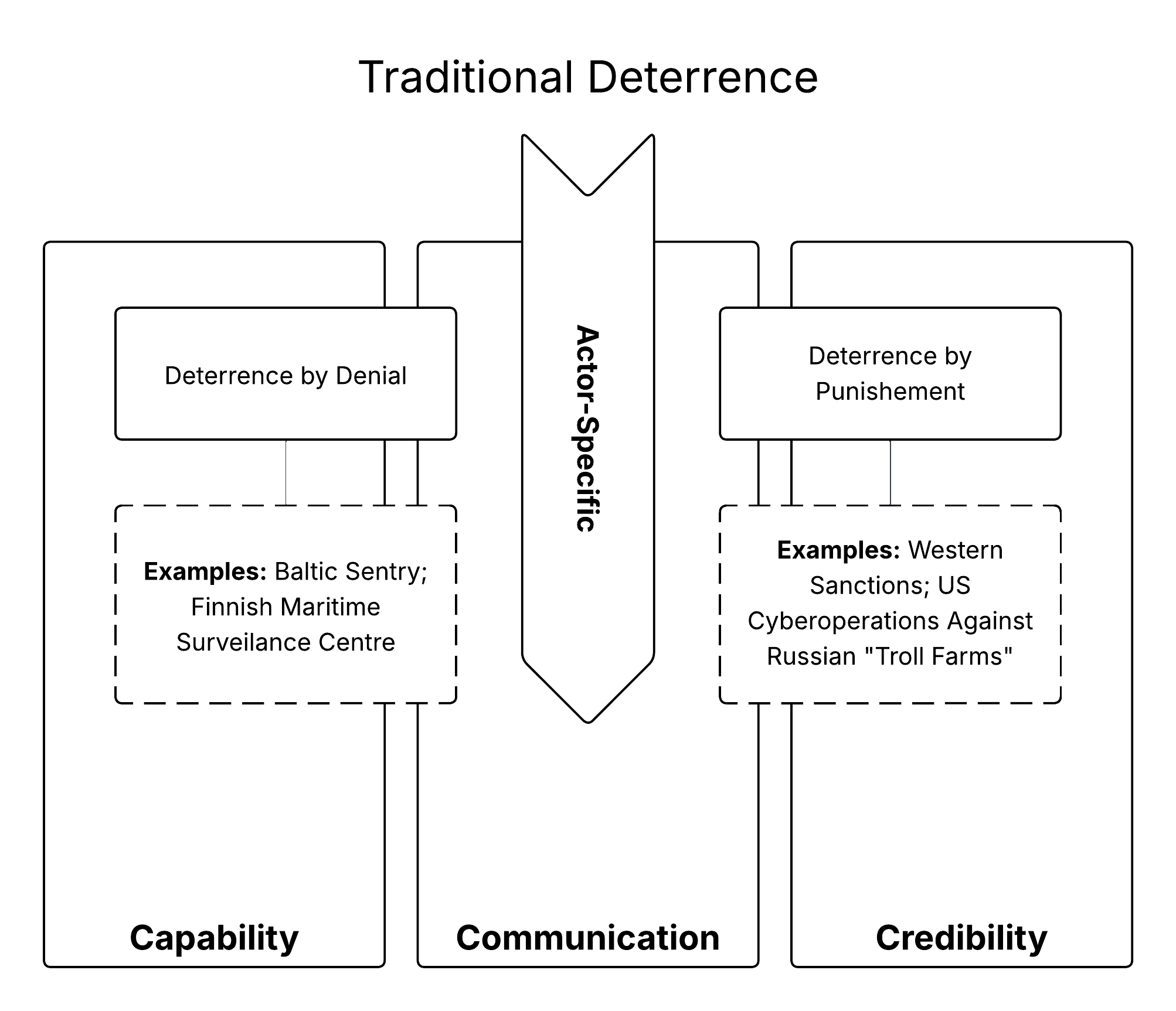
Deterrence strategies still widely used today were first developed by the US strategic thinkers right after the WW2. Since then, the key guiding principle behind deterrence has remained the same: convincing the adversary that the costs and risks of a given action outweigh its potential benefits. In this traditional understanding, deterrence strategy is built around three key approaches.
Tailored deterrence, which implies that deterrence must always be designed for a specific adversary. Good intelligence on an adversary’s capabilities, but, more importantly, on their intentions and motivations, is therefore key. To put it simply, what works for Russia won’t necessarily work for China and vice versa.
Deterrence by denial, which implies preventing the adversary from acquiring the means to attack or making the attack too costly. Essentially, it is about complicating the attacker's task as much as possible and building one’s defensive capabilities. This approach is currently in action in the Baltic Sea region, exemplified by the Baltic Sentry mission and the newly launched Finnish maritime surveillance centre.
Deterrence by punishment, which implies stopping the adversary through the threat of severe retaliation. This approach has been exemplified by a multitude of sanctions imposed on the Russian state and the non-state actors it leverages.
For these traditional approaches to work, effective signaling is essential, and it rests on three key pillars: capability, credibility, and communication. In other words, for deterrence to work, we must clearly communicate to the adversary that we have the capability to overpower them and, more importantly, we are willing to do it.
Figure: Principles behind traditional deterrence.
Adapting deterrence for hybrid threats
Although deterring hybrid threats remains a complicated issue, to say the least, some research suggests that this challenge can be addressed by adapting traditional deterrence strategies to include several additional approaches, including, but not limited to:
Deterrence by defiance, which implies determination in the face of an attack and ensuring that the targeted state does not react in the way the perpetrator seeks. Key examples of this approach can be found in the Baltic states, which, despite Russian threats post-2022, have continued to support Ukraine and reduced the Kremlin’s influence in their domestic politics.
Deterrence by degradation, which implies removing or weakening an adversary’s capabilities. Recently, significant efforts have been made in this regard in the cyber domain, with operations such as Medusa and Eastwood targeting Russian malware and cybercrime networks.
Deterrence by delegitimization, which implies making certain hybrid threat activities or the adversary’s overall goals unacceptable. The aim is to undermine the legitimacy of these actions in the eyes of its supporters. More recently, this approach has been used in Moldova, where Russian election interference was exposed and linked to bribery and corruption – two topics that are highly sensitive in Moldovan society.
And finally, deterrence by collaboration, which implies that deterrence should be conducted in collaboration with international and non-governmental partners rather than alone.
Conclusion
Deterrence is not some sort of wunderwaffe that will always stop perpetrators from using hybrid threats. Unlike during the Cold War, when deterrence operated in a relatively stable environment of power parity and more predictable, rational actors, today’s hybrid threat landscape is far more fragmented and ambiguous. Nonetheless, deterrence must be used even in these dire conditions. Therefore, an effective hybrid threat deterrence strategy should take several factors into account.
First, know your enemy. Good situational and strategic awareness is essential for developing any form of deterrence strategy. Investing in strong intelligence capabilities is therefore a must.
Second, tailored deterrence is key to targeting what specific adversaries value most. Generic, one-size-fits-all deterrence strategies simply do not work. Targeted countries should develop different strategies for each adversary: one for Russia, one for China, and so on.
Third, cooperation and coordination with both domestic and international state and non-state actors are important. This is especially true for democracies, which have strong civil societies that can support government efforts and good relations with like-minded nations.